Tests were performed on the ForceField FFTM headband / headgear in accordance with the standard specification* for headgear used in soccer at an independent laboratory certified to test the headgear in accordance with ASTM F2439. The ForceField headband / headgear passed all tests in accordance with the protocol set forth in the standard. It should be noted that Dr. Abraham was and still is a member of the ASTM committee that was responsible in the creation of that standard and as well as the re-approvals up through 2011*.
In addition, the same tests and more rigorous testing was performed by independent laboratories in Europe. As a result of six months of independent testing, the ForceField FF Protective Headband/Headgear was awarded the CEII Mark which designated the ForceField products as "Protective Headbands." This designation was required to legally distribute the ForceField products throughout Europe, the Far East, Canada, Australia and New Zealand.
The test results that are shown below is additional test data performed on the ForceField headgear exposing the ForceField headbands to much higher impacts that were required in the ASTM F2439 standard. The tests illustrate the effective absorption and dissipation properties of the headgear when exposed to significantly higher forces equivalent to the testing protocol applied to protective headgear used in other sports such as ice hockey and baseball.
Based upon the results of all of the tests that were performed in accordance with ASTM F2439, the undersigned has both the experience (refer to www.scientificadvisory.com) and authority to test the ForceField headgear at independent laboratories, approve and certify the results in accordance with the Standard.
Dr. C. J. Abraham,
PhD, JD, PE, CPC, FRSC, DEE, FTI, BCFE, DCEE, CChE, CChem
Technical Director, ForceField FF (NA), Ltd.
The ForceField FFTM Headband - Additional Impact Testing
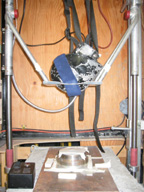
Drop Test Apparatus The headform was mounted to permit impact between the mid anterior - crown locations.
The ForceField FFTM Headband was tested under the same rigid test conditions that a hockey helmet is tested.
The test method used was ASTM F 1045 titled "Standard Performance Specification for Ice Hockey Helmets". In that test, the hockey helmet is a complete product containing a liner of shock absorbing material covered with a hard plastic shell which gives the helmet its form and helps spread out the initial impact over a larger area. No single impact can exceed 300Gs.
The velocity of the 41-inch drop was 4.48 meters per second.
The results averaged 252.9Gs for the headband.
The ForceField FFTM Headband passed the ASTM F 1045 test protocol.
In comparison, a bare NIKE band did not have any noticeable affect in absorbing any impact of any significance.
Purpose:
This report summarizes the results of preliminary testing to determine the impact absorption performance characteristics of prototype headbands for soccer.
Method:
The independent measure of interest was peak G (i.e. impact deceleration).
The dependent variable of impact velocity and energy were held constant at 1.9 m/s and 9.2 J, respectively.
An ISO headform (size L ~ medium adult) with triaxial accelerometer (Kistler) mounted at the approximate center of mass was dropped by means of a bi-rail basket guide (similar to CEN 960 for ice hockey) from a height of 30 cm (see figure 1).
Ten initial tests were conducted without any headbands mounted to provide baseline measures. Three impact per sample were conducted with approximately 30 seconds between impacts.
The initial ten impacts without headbands produced peak G values of 652.4 G’s. With the new patented headbands introduced, impact absorption (i.e. the ratio between no head band versus with headband) demonstrated values up to 83% (decrease in impact force) (average of three impacts).
Test Protocol:
ASTM F 1446-04
The impact test apparatus complied with ASTM F 2220-02.
Drop height : 40.6 inches
Impact velocity: 4.41-4.59 m/s
Impact Surface: MEP Pad-N594
ANSI/DOT Headform size: C
Steel flat anvil except for (*) triangular anvil with batter’s helmet
The test results are as follows:
Sample Description
Impact Surface
Impact Site
Peak g’s
Batter’s helmet*
Triangle anvil
Right side
455.57
Batter’s helmet with ForceField FFTM Headband (1)*
Triangle anvil
Left side
240.23
47% reduction
Headform only
MEP N330
Crown
390.14
ForceField FFTM Headband (1)
MEP N330
Crown
240.23
38% reduction
* With triangular hazard anvil (extremely severe test)
(1) PATENT NOS.: US 6,675,395, US 6,978,487 & US 7,234,174.
Testing Protocol
The testing of the helmet insert and protective device was independently performed.
The test method used was ASTM F 1045 with a 41" drop.
The protocol was used to determine the feasibility of the concept of adding the patentented headband (1), the consistency for a variety of protective helmets and whether the results would make a significant difference in the absorption and dissipation of forces. A small change would not be useful.
Franklin Youth Batting Helmet
(Location - ear)
As is
271 gs
With patented insert (1)
173 gs
Difference minus 98 gs or a reduction of 36%
Bauer/Nike Hockey Helmet
(Location - left & right ear)
As is
144.53 gs
With patented insert (1)
96.19 gs
Difference minus 43.34 gs or a reduction of 33.4%
Bauer/Nike Hockey Helmet
(Location - left & right ear)
As is
144.53 gs
With NIKE sweatband
140.14 gs
(No effect, within experimental error)
JOFFA 390 Senior Hockey Helmet
As is
128.91 gs
With patented insert (1)
87.8 gs
Difference minus 41.1 gs or a reduction of 31.9%
NIKE Batting Helmet
(Location - left & right ear)
As is
272.95 gs
With patented insert (1)
174.80 gs
Difference minus 98 gs or a reduction of 35.9%
Client:
Scientific Advisory Services LTD, Dr. C. J. Abraham
Product:
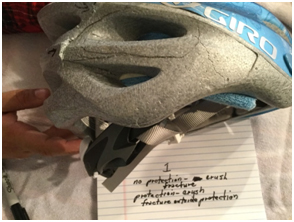
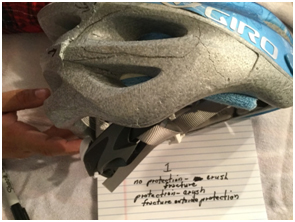
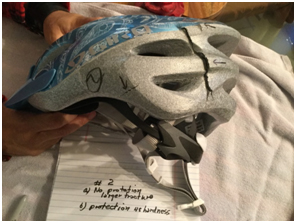
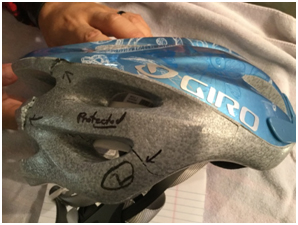
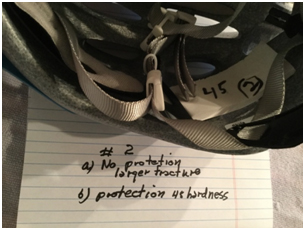
Bell Giro Skyla Women's Bicycle Helmet with and without ForceField FF Protective Padding Placed Around Internal Circumference of Helmet
Model No.:
ForceField FFTM Protective Head Band Padding Tested on the Bell Giro Skyla Women's Bicycle Helmet
Standard:
EN 1078:1997
Tested:
12 January 2016
SHOCK ABSORBING CAPACITY:
Section 4.4 Flat Anvil Head Form Size: E Drop Height: 60" Impactor Weight: 4.7 kg
Lab Temp.:
67 degrees Farenheit
Lab Humidity:
49%
Sample #
Location
Description
Velocity (m/s)
Force (g)
1
Right Rear Temporal
No Padding
5.28
167.13
1
Left Rear Temporal
Padding (35)
5.25
119.94
2
Right Rear Temporal
No Padding
5.27
152.64
2
Left Rear Temporal
Padding (45)
5.27
119.59
The head form weighed approximately 11 pounds and was dropped from a height of 5 feet (60-inches) using an accelerometer. The average velocity was approximately 12.5 miles per hour (5.37 meters per second).
Although the polymeric material used in the ForceField FFTM Headgear was not optimized with reference to the objective of reducing the impact force in reference to the unprotected tested bicycle helmet, the amount of improvement with the ForceField Headgear on the subject Bell Giro Skylar bicycle helmet was 28.24% for sample #1 and 22% for sample #2.
PATENTS:
US 6,675,395
US 6,978,487
US 7,234,174
US 6,272,692
2008/03600 (South Africa)
PCT/US 2005/034267 (International-European)